The Method
We are drowning in expert opinion. Pick any issue. Coffee causes cancer, unless it prevents cancer. Red wine is good for you, unless any alcohol gives you cancer. Omega-3s protect your heart, unless they do nothing at all. Whatever position you already hold, on whatever issue, there is a study behind it.
So we do the sensible thing. We look to authoritative sources, people whose job it is to know. We outsource our reasoning to somebody else.
The problem is that the authoritative sources are just as iffy. They have their own interests, agendas, and biases. Many operate under publish-or-perish pressure, which pushes ordinary researchers to squint at their data hard enough that a thin study looks publishable. Even setting the incentives aside, people make mistakes. After the 2008 crisis, a widely cited Harvard study on austerity shaped policy in Greece and elsewhere. It turned out to have accidentally omitted several rows of a spreadsheet. The correction flipped the conclusion. The mistake may have been honest, the consequences were severe.
We cannot stop bad claims from being published. What we can do is stop outsourcing our thinking. To do that, we go after context.
Context is everything. It is the rest of the picture. A single pixel out of context tells you nothing; put it back in the frame and it is obvious what it is. Without the frame, you cannot agree with a claim, cannot disagree with it, and cannot meaningfully use it. You are just guessing.
The response sounds simple: learn to build that context yourself. But critical thinking is treated as a required skill far more often than it is taught as a usable one. Most instruction falls short in one of two ways. It either stays at the level of abstract concepts that never touch a live claim, or it reduces critical thinking to a list of fallacies to recognize after the fact. What is usually missing is a procedure: a way to move from a claim in front of you to the context needed to judge it.
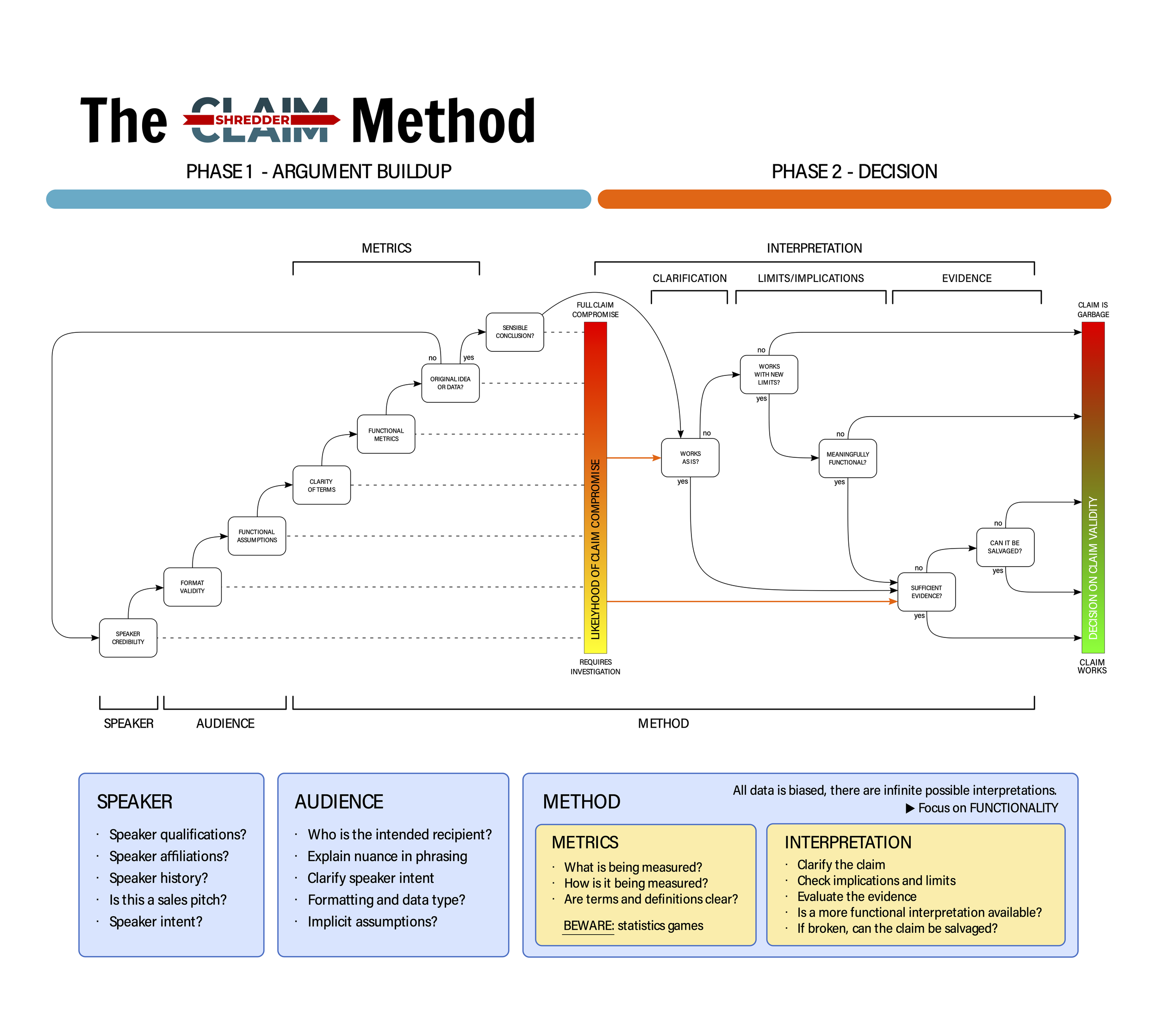
The Claim Shredder Method supplies that procedure. It is a step-by-step way to build the context a claim needs, in any field, without specialist jargon.

How do you get context? Which context? How much? When are you done? Those are the questions the method answers. It runs in two phases, both of them context work.
Phase 1: Structure the context.
Every claim sits on a structure that decides what the claim can mean. Three axes surface it: who is speaking, to whom, and with what metrics. Building that structure back out is the first pass. Each axis exposes something the compressed claim was hiding.
Phase 2: Interpret the context.
Interpretation is where meaning lives. Once the structure is out, three interpretive moves pressure it toward completeness: clarification (what is actually being said?), limits and implications (where does the claim reach, and where does it stop?), and evidence (is the support actually there?). The register is charitable, not combative: assume the claim works, then interrogate carefully. What functions, stays.
At the end of Phase 2, the context is complete enough that the verdict is no longer a matter of opinion. Claims land on a spectrum from Valid to Garbage. Where a specific claim falls is not something the reader decides. It is what the accumulated context makes visible.
Working with AI
The Claim Shredder Method was built for claims that arrive with confidence but no verification. AI is that problem, at scale.
Three features make AI structurally hard to trust.
Sycophancy. AI is trained to produce responses users approve of. Give it a bad argument and say you agree, and it develops the bad argument. Ask it to critique the same argument, and it tears it apart. Same argument, opposite outputs, only the framing changed. Sycophancy is structural, not stylistic. Every current model has it in some form.
No "I don't know." A working analyst says "I do not know yet" when the evidence isn't there. AI is structurally pushed the other way: generate a confident answer anyway. That's how court briefs end up with fabricated case citations, chatbots invent refund policies, and city-run services tell business owners to break the law.
Same problems, at scale. AI does not create new logical failure modes. It runs the ones already in the Method (missing context, vague terms, absolute claims without support) faster, more confidently, and everywhere at once.
The Method already teaches the discipline of checking whether a thing actually is what it's being called: whether an answer actually answers, whether a citation actually exists, whether a summary actually reflects its source.
AI as an interrogator, not a generator.
When AI is used to generate authoritative answers, sycophancy and confabulation slip in unchecked. When AI is used to interrogate ideas, it applies pressure to the structure of an argument without taking a side (an approach presented at the DePaul Center for Teaching and Learning conference in May 2026). Used this way, AI sharpens critical thinking, instead of outsourcing it.